
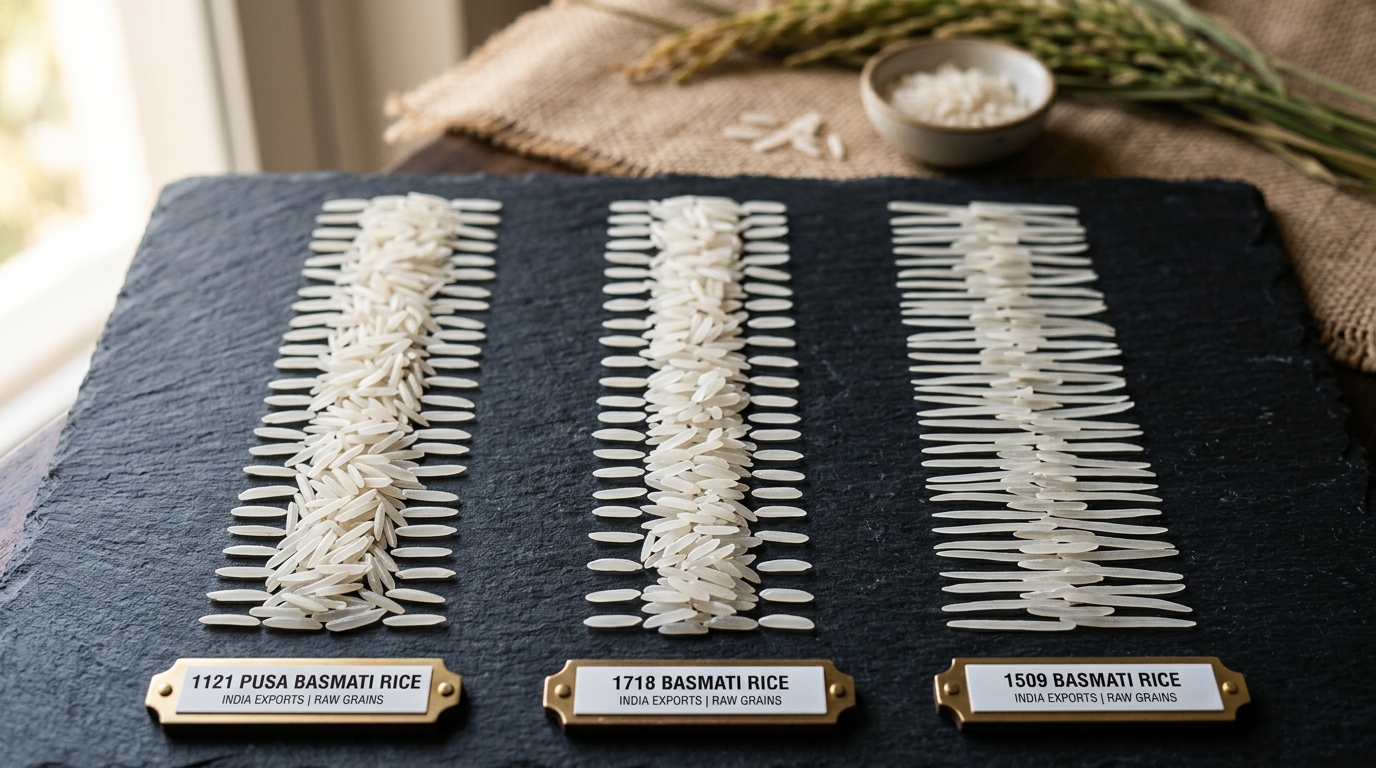
Choosing the right Basmati variety is the most critical decision for a bulk rice importer, as it directly impacts your freight cost, cooked grain volume, and consumer satisfaction. While 1121 Basmati, 1718 Basmati, and 1509 Basmati are all premium long-grain varieties originating from India, they differ significantly in cultivation cycles, grain length stability, and regional market pricing.
This guide provides a technical and commercial comparison of these three crops to help B2B buyers select the optimal variety for their regional demographics and distribution channels.
Key Takeaways for Procurement Officers
- Longest Grains: 1509 Basmati holds the record for raw length (up to 8.55 mm), but 1121 Basmati remains the world leader in cooked elongation, expanding up to 3 times its raw size.
- Price vs. Performance: 1509 Basmati is the most cost-effective premium option because of its short cultivation window and higher crop yield.
- Supply Chain Stability: 1718 Basmati is a disease-resistant clone of the 1121 variety, offering identical physical parameters (8.35–8.45 mm) but with less pricing volatility due to stable harvest yields.
- Regional Preferences: GCC markets (Saudi Arabia, UAE, Kuwait) prefer 1121 and 1718 Golden Sella, while European and UK retail chains demand 1121/1718 Creamy Sella in smaller retail packaging.
Which Specifications Distinguish Premium Basmati Crops?
The physical differences between these three varieties lie in their average grain length (AGL), cooked elongation ratio, and disease resistance. Importers must evaluate these specifications to ensure compliance with local import standards and consumer expectations.
Here is the verified technical specification mapping for raw and processed grains:
| Technical Parameter | 1121 Basmati Rice | 1718 Basmati Rice | 1509 Basmati Rice |
|---|---|---|---|
| Average Grain Length (Raw) | 8.35 mm – 8.45 mm | 8.35 mm – 8.45 mm | 8.35 mm – 8.55 mm |
| Elongation Ratio (Cooked) | 3.0x (Up to 24 mm+) | 3.0x (Up to 24 mm+) | 2.2x – 2.5x (Up to 20 mm+) |
| Cultivation Cycle | ~145 Days | ~135-140 Days | ~120 Days |
| Yield per Acre | Lower (Premium pricing) | Moderate | Higher (Cost-effective) |
| Blight Disease Resistance | Low (Susceptible to rain damage) | High (Blight-resistant clone) | Moderate |
| Moisture Content (Max) | 12.5% | 12.5% | 12.5% |
| Broken Tolerance | < 1% | < 1% | < 1% |
| Damaged & Discolored | < 1% | < 1% | < 1% |
How Grain Length and Elongation Affect Foodservice Yields
A rice grain’s length before and after cooking determines its value to commercial foodservice operations, such as restaurants and hotels. Grains that expand uniformly without breaking provide a higher plated volume per raw kilogram, directly reducing a kitchen’s portion cost.
While 1509 Basmati has a raw grain length that can reach up to 8.55 mm, it has a lower cooked elongation ratio (around 2.2x to 2.5x) compared to the legendary 1121 Basmati (which reaches 3.0x elongation). 1718 Basmati, being a direct biological descendant of 1121, inherits its parent’s 3.0x elongation properties.
If your target buyers are restaurants or catering businesses that prepare large-scale Biryani or Mandi dishes, 1121 or 1718 Basmati is the industry standard. Their cooked grains remain separate, non-sticky, and fluffier. 1509 Basmati, though still highly premium, is best suited for daily home cooking and budget-conscious retail brands.
Why Regional Preferences Vary Across the GCC and Europe
Consumer rice preferences are not uniform; they are deeply rooted in regional culinary traditions and buying habits. Importers must match the processing variant—Steam, Creamy Sella, Golden Sella, or Raw—to the specific country they serve.
GCC Markets (Saudi Arabia, UAE, Kuwait, Qatar, Oman)
Buyers in the Gulf region overwhelmingly prefer Golden Sella (Parboiled) Basmati. The parboiling process gelatinizes the starch inside the grain, making it tough enough to withstand slow-cooking with meat and spices without turning mushy.
- Saudi Arabia & UAE: High demand for 1121 Golden and 1718 Golden in 5 kg, 20 kg, and 25 kg bag sizes.
- Kuwait: Prefers 1121 Creamy and 1718 Creamy Basmati in 5 kg and 20 kg bags.
- Oman: Displays high demand for 1509 Sella in 5 kg and 25 kg bags as a high-value, cost-effective alternative.
Western Markets (Europe, United Kingdom, USA, Canada)
European and North American buyers prioritize organic credentials, low pesticide residues, and smaller retail packaging.
- Europe & UK: Highest demand for 1121 Creamy and 1718 Creamy Basmati packed in 1 kg, 2 kg, and 5 kg bags.
- Canada: Prefers 1121 Steam Basmati in 5 kg and 10 kg retail packs.
Practitioner Insights: What Experienced Importers Know
Milling experts and seasoned procurement officers look past the initial price per metric ton to calculate the true cost of their shipment. Here are three critical parameters that dictate import margins:
1. Crop Volatility and Blight Damage
1121 Basmati crops are delicate and prone to bacterial leaf blight. A bad monsoon season in Haryana or Punjab can decimate yields, causing sudden price hikes mid-contract. By switching to 1718 Basmati (which was specifically bred to resist leaf blight), importers get the exact same grain specifications but benefit from a more stable supply chain and predictable pricing.
2. The Starch Difference: Sella vs. Steam
Steam rice is subjected to brief steam exposure before de-husking, preserving the natural aroma of raw Basmati while ensuring the grain is clean. Sella (parboiled) rice undergoes a complete hydro-thermal process (soaking, vacuum steaming, and drying). Sella has a much higher tolerance for overcooking and offers a longer shelf life, whereas Steam rice retains a more potent, authentic Basmati fragrance.
3. Packaging Integrity and Condensation
Basmati shipped across oceans is highly sensitive to moisture. Premium brands shipping to Europe or the USA use BOPP (Biaxially Oriented Polypropylene) Laminated Bags (available from 1 kg to 25 kg) because they provide a complete barrier against humidity and insects. For bulk wholesale shipments to Africa or the Middle East, PP Woven Bags (25 kg to 50 kg) are preferred due to their high tensile strength and lower packaging cost.
Procurement Decision Matrix
To streamline your selection process, match your market situation to the recommended crop variety:
| Target Market / Situation | Best Rice Variety | Recommended Processing | Recommended Packaging |
|---|---|---|---|
| Premium Restaurants & Hotels (GCC) | 1121 Basmati | Golden (Sella) | 20 kg / 25 kg PP Woven Bags |
| Western Retailers (EU, UK, USA) | 1718 Basmati | Creamy / Lemon | 1 kg / 5 kg BOPP Bags |
| Value Brands & Supermarket White-Label | 1509 Basmati | Steam or Sella | 5 kg Stand-Up Zipper Pouches |
| High-Volume Institutional Catering | 1509 Basmati | Golden (Sella) | 25 kg Jute or PP Woven Bags |
Request a Technical Specification Sheet
Gurukripa Parboiling processes all Basmati varieties at our state-of-the-art facility in Waraseoni, Madhya Pradesh. We perform mandatory batch cooking tests and Sortex color-sorting on all export shipments, ensuring less than 1% broken grains and a guaranteed 24-month shelf life.
If you require physical sample pouches, container loading calculations, or a CIF/CFR price quote, please contact our export department.
- Primary Action: GET BULK PRICE
- Secondary Action: WHATSAPP EXPORT TEAM